Stop Paying ₦1.5M Rent for a 2-Bedroom Flat in Asaba in 2026
These 5 Zones Have 2-Bedroom Flats for ₦500k (With Proof)
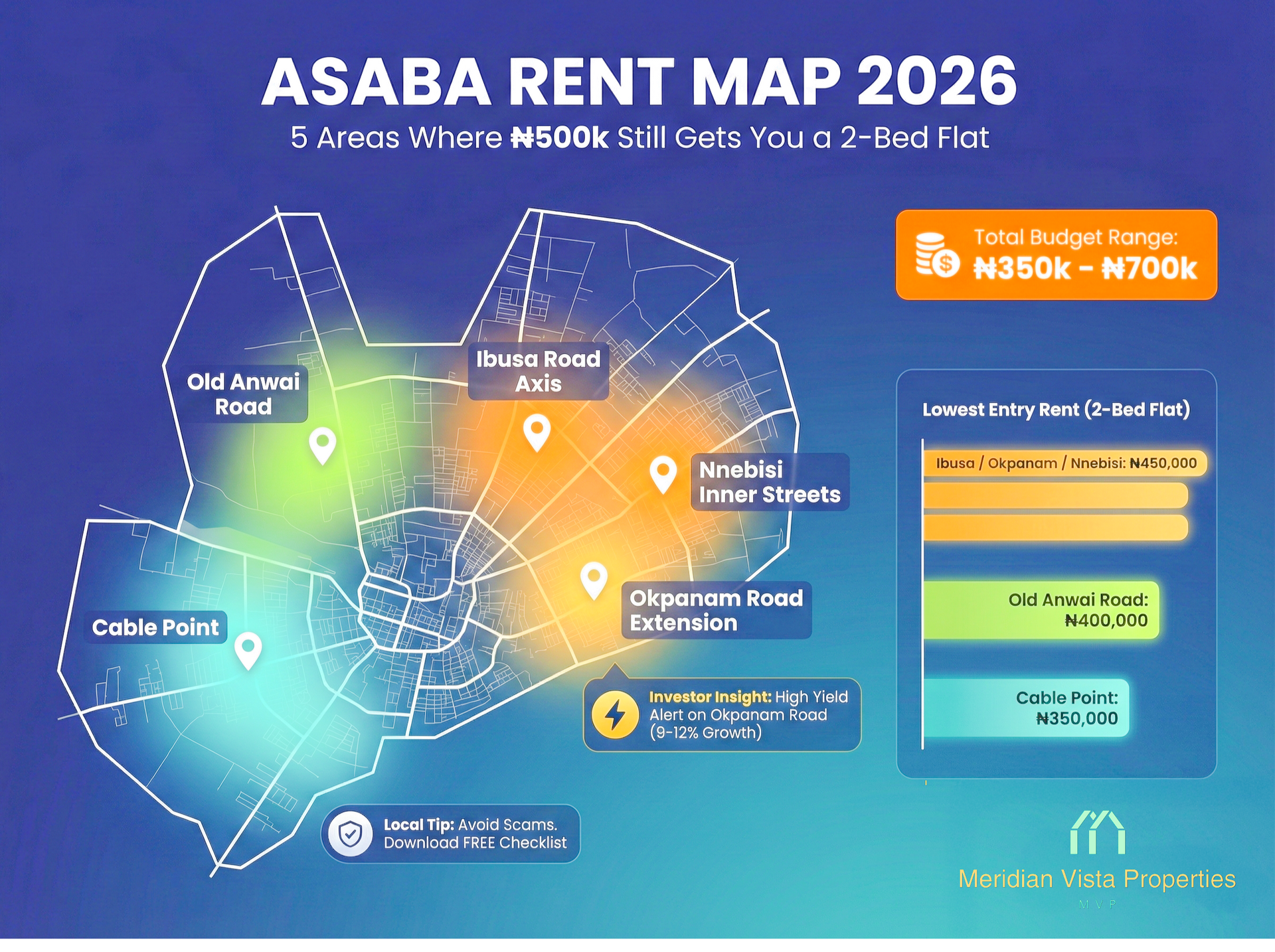
Finding Your Home in the Emerging Capital
Asaba, the capital of Delta State, is undergoing rapid transformation shaped by its rich history, strategic position, and emerging trends. As the state's administrative center, it houses vital government operations and institutions.
The city's role as the primary gateway to the South East has gained heightened importance, with economic growth in the South East region and persistent security challenges prompting substantial migration into Asaba.
Located directly across the Niger Bridge, Asaba is witnessing unprecedented expansion, with projections indicating current land values may triple by 2027. This boom, however, is putting substantial pressure on the rental sector, creating both opportunities and challenges for residents and investors alike.
For many residents, the goal is a comfortable, secure 2-bedroom flat that doesn't break the bank. While the high-end areas command rents well over ₦1.5M, our on-the-ground market analysis confirms that affordable, quality options still exist if you know where to look.
This guide, compiled from our latest 2026 market data, reveals the five best areas where you can secure a 2-bedroom flat within a reasonable budget, while also offering crucial insights for investors looking for high-occupancy rental zones.
Why You Can Trust Our Data
Our rental data is compiled through direct surveys conducted locally and verified from actual rental transactions in the market. The prices listed below represent annual rent only. Please note that these figures do not include mandatory additional fees—such as Agency fees, Tenancy agreement fees, Caution fees, and other related charges—which typically increase the total initial payment package by 30% to 50% above the quoted annual rent.
Important: With property prices projected to increase by 5-15% annually, the rental prices shown here are subject to upward adjustments and should be considered as baseline figures that may change.
1. Ibusa Road Axis (Ibusa Junction to Koka Junction)
Geographic Coverage: This corridor spans from Ibusa Junction through to Koka Junction, just before the Onitsha-Asaba Expressway, capturing one of Asaba's most dynamic residential zones.
- Local Appeal: Excellent proximity to Asaba's city center, major transport links, and essential amenities including Ogbe-ogonogo modern market (the most prominent and busiest wholesale and retail market in Asaba), schools, worship, and commercial centers. The area features an established, lively community atmosphere ideal for commuters and families needing quick access to daily essentials.
- Investor Appeal: This is arguably the safest bet for rental income stability in Asaba. The corridor maintains near-100% occupancy rates due to its strategic central location, delivering consistent rental yields of 8-10%. Properties here rarely stay vacant, with sustained demand from working professionals and families.
2. Okpanam Road Extension (Strategic Suburbs & Emerging Zones)
Geographic Coverage & Access: While accessed via the main Okpanam Road, finding affordable rental apartments in this corridor requires strategic positioning. Affordable opportunities are concentrated in the outskirts and less-developed pockets away from the main road.
- Local Appeal: This emerging suburb offers newer housing stock, improved infrastructure including better road networks and drainage systems in select estates, and a quieter, more residential environment. It sits within a short drive from major shopping hubs like Shoprite, making it attractive for families seeking suburban tranquility with urban conveniences.
- Investor Appeal: Okpanam Road Extension is cited as one of Nigeria's top emerging markets, offering strong potential for capital appreciation (9-12% yields) as the area attracts more commercial growth and new residents. This is a long-term play—investing in land now and developing rental units positions investors to benefit from the area's evolution as a secondary hub.
- The Reality Check: Property quality and pricing vary dramatically. Inner streets in less-developed zones may lack paved roads or consistent power supply, requiring thorough inspection.
3. Nnebisi Road Inner Streets & Umuagu (The Central Value Districts)
Geographic Coverage & Access: Nnebisi Road sits at the geographic heart of Asaba. The inner streets and adjoining residential layouts (including behind the Stephen Keshi Stadium, Nwa Ezeapu Street, and Onochie lane) offer housing that benefits from this prime accessibility. Adjacent to this central zone lies Umuagu, one of Asaba's five historic quarters.
- Local Appeal: Nnebisi Road offers unbeatable access to major banks, shops, government offices, and commercial activities. Umuagu has become a sought-after residential area due to its interconnectivity with other core areas of the city (DLA road, Jesus Saves road, Ibusa road) and its strong sense of community, low crime rate, and great schools.
- Investor Appeal: Nnebisi's inner layouts offer unique commercial potential. Umuagu drives consistent rental demand with yields typically ranging 7-9%, plus appreciation potential as urban expansion continues. Both areas maintain low vacancy risk due to their central positioning.
- The Reality Check: In Nnebisi's inner streets, security and noise levels can vary dramatically. Although Umuagu features reliable infrastructure, certain streets may not have the refined finish of more modern areas.
4. Old Anwai Road (The Academic & Heritage Quarter)
Geographic Coverage: The Old Anwai Road runs through central parts of the city, from FMC to the road leading to Government House and the golf club. Its proximity to the Dennis Osadebay University (former Delta State University Anwai Campus) heavily influences the housing market.
- Local Appeal: Old Anwai Road offers a serene, family-oriented environment with unbeatable proximity to educational institutions, government offices, and recreational amenities. It is popular among students, young professionals, and families due to its affordability and convenience.
- Investor Appeal: The academic community drives steady rental demand with consistently low vacancy rates and reliable yields of 8-10%. The university's institutional permanence makes this a fundamentally secure long-term investment. Proximity to Government House also attracts civil servants and political appointees.
- The Reality Check: While infrastructure is generally good, some older properties may require renovation. Parking can be limited, and the area's established nature means land prices are higher than emerging suburbs, reducing speculative appreciation potential.
5. Cable Point (Select Areas): The Budget-Friendly Option
Geographic Coverage: Cable Point is one of Asaba's oldest areas, holding significant historical value as the legendary founding site of the city. It is a waterfront neighborhood known for its scenic location along the Niger River.
- Local Appeal: Strong sense of community, proximity to the River Niger, and the lowest entry price point for a 2-bedroom flat.
- Investor Appeal: High-volume, low-cost rental market. Ideal for investors targeting the lower-to-middle income bracket with guaranteed occupancy.
- The Reality Check: Infrastructure can be inconsistent. This area requires the most careful on-site inspection before commitment, largely because of the quality of people found in the location who are mostly artisans and traders.
Unified Asaba 2-Bedroom Rental Data (2026 Baseline)
The table below consolidates the typical annual rent ranges for a standard 2-bedroom flat in the five key areas of Asaba.
| Area/Corridor | Property Type | Typical Annual Rent Range (₦) | Strategic Note |
|---|---|---|---|
| Ibusa Road Axis | Old Standard Finish (PVC) | ₦450,000 – ₦550,000 | Highest occupancy, safest rental income. |
| Okpanam Road Extension | Old Standard Finish (PVC) | ₦450,000 – ₦700,000 | Highest capital appreciation potential. |
| Nnebisi Inner Streets | Inner Layouts | ₦450,000 – ₦600,000 | Central location, commercial proximity. |
| Old Anwai Road | Basic/Older | ₦400,000 – ₦550,000 | Academic stability, low vacancy risk. |
| Cable Point | Basic/Standard | ₦350,000 – ₦550,000 | Lowest entry price point, high volume. |
Frequently Asked Questions
Can I start investing in real estate in Nigeria without a lot of money?
Yes — and this is perhaps the most important thing to understand about real estate in Nigeria. You do not need to be wealthy to begin. My father was a petty trader with modest savings when he bought his first plot of land. What matters is not the size of your starting capital but the decision to start. Many people are waiting to feel financially comfortable before they invest, but that comfort rarely arrives on its own. A small plot of land in an emerging area — bought early and held patiently — will always outperform a large savings balance sitting idle in a bank account. The entry point for real estate in Nigeria is far lower than most people assume. Start where you are, with what you have.
How does land appreciate in value in Nigeria?
Land in Nigeria appreciates through a combination of infrastructure development, population growth, commercial migration, and government attention. When a government begins building roads, markets, or public facilities in an area, businesses and residents follow. As more people move into an area, demand for land increases — and with demand comes higher prices. This is exactly what happened in the story above. A piece of land that appeared worthless in the early 1990s became a prime commercial address once the surrounding city began expanding toward it. The key insight is that land does not create its own value — the activity around it does. Buying ahead of development, in areas where growth indicators are already visible, is the core strategy behind every successful real estate investor in Nigeria.
Is real estate a good investment in Nigeria in 2026?
Real estate remains one of the most reliable wealth-building vehicles available to Nigerians, particularly in fast-growing cities like Asaba, Enugu, and Abuja. While inflation, currency fluctuation, and economic uncertainty create anxiety in financial markets, land and property consistently hold or increase their naira value over time. In fact, periods of economic uncertainty are historically when the smartest property purchases are made — because hesitation from the majority creates opportunity for the few who act. Cities like Asaba in Delta State are currently experiencing significant infrastructure investment, commercial growth, and population influx, making them particularly attractive for both short and long-term real estate investment in 2026 and beyond.
What are the risks of buying land in Nigeria and how do I avoid them?
The most common risks when buying land in Nigeria include purchasing land with disputed ownership, buying without a verified title document, dealing with unregistered land agents, and purchasing in areas with no clear development trajectory. Here is how to protect yourself: Always verify the land title — the most secure documents in Nigeria are a Certificate of Occupancy (C of O) or a Governor's Consent. Never buy from an individual without involving a registered estate agent or property lawyer. Conduct a land search at the relevant state's Land Registry before any payment. Insist on a proper deed of assignment or contract of sale. Work with reputable, verifiable real estate companies — such as Meridian Vista Properties — who conduct due diligence on every listing they present to clients.
How long should I hold land before selling it in Nigeria?
There is no universal rule, but the general principle is this — the longer you hold land in a growth corridor, the greater your return. In Nigeria's emerging cities, significant appreciation typically begins to show within 5 to 10 years of purchase, and compounds substantially between 10 and 20 years. The story in this post is a perfect illustration: a plot purchased in the early 1990s had appreciated dramatically by the early 2000s — roughly a decade later. That said, the right time to sell is determined by your personal financial need and the maturity of the market around your land, not by an arbitrary timeline. The worst reason to sell land is impatience. The best reason is that the land has served its purpose in your wealth-building strategy and a better opportunity is available.
Why is Asaba a good place to invest in real estate?
Asaba, the capital of Delta State, has emerged as one of the most attractive real estate markets in southern Nigeria for several compelling reasons. First, infrastructure: the city has seen consistent government investment in roads, utilities, and public facilities, making it increasingly livable and commercially viable. Second, geography: Asaba sits at a strategic crossroads — close to Anambra State, connected to the Niger Bridge which is the gateway into the south east, and accessible from both the south-south and south-east geopolitical zones, giving it a natural commercial advantage. Third, affordability: compared to Lagos and Abuja, Asaba still offers entry-level land and property prices that represent significant upside potential. Fourth, growth trajectory: Asaba is a city on the rise — population influx, new businesses, and expanding residential demand all point to continued appreciation. For investors seeking high returns in an underpriced, high-growth market, Asaba is one of Nigeria's most compelling opportunities right now.
What is the difference between building wealth and earning salary?
A salary is income — it flows in when you work and stops when you do not. Wealth is ownership — it grows while you sleep, continues when you are ill, and outlasts you entirely. The fundamental difference is that a salary trades your time for money, while ownership makes your money work independently of your time. In practical terms: a salary pays your rent, your school fees, your food, and your lifestyle — but it rarely creates surplus fast enough to change your financial position. A property asset, on the other hand, does three things simultaneously: it holds value against inflation, it can generate rental income, and it appreciates over time — creating wealth that compounds without requiring your daily effort. The lesson from this story is not that salaries are bad. It is that salaries alone are not enough. Ownership is what converts a working life into a lasting legacy.